
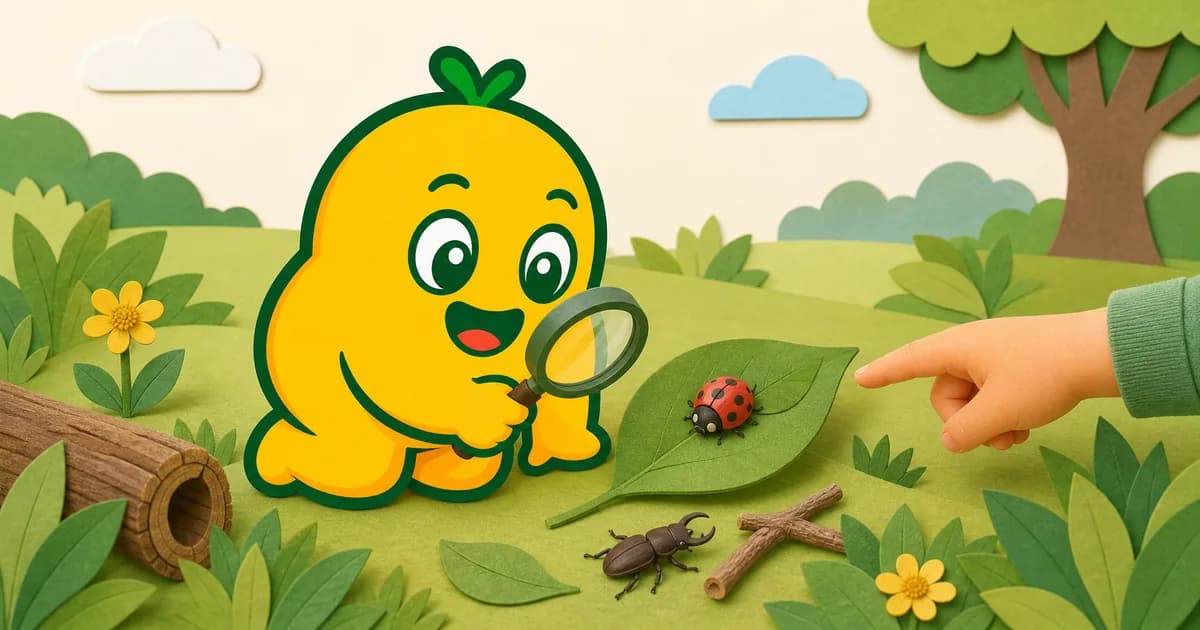
Small creatures reward slow observation
Insect observation can begin with something as simple as watching an ant cross a path or a ladybug rest on a leaf. Children do not need to catch an insect to notice its color, shape, movement, or habitat. Looking from a respectful distance keeps the activity calmer for both the child and the insect.
KORENANI has an Insect recognition mode that families can use for photos of insects. Recognition may be incorrect, so use a result as a clue for further comparison—not as a safety judgment or a reason to handle an unfamiliar species.
A four-step observation routine
1. Stop before moving closer
Ask your child to watch where the insect goes. Is it on a flower, under a leaf, near soil, or on a tree? A few seconds of observation can reveal details that a still photo does not show.
Useful prompts include:
- How many legs can you see?
- Does it crawl, jump, or fly?
- What colors or patterns are visible?
- What is it resting on or eating?
2. Keep hands back
Do not touch, pick up, or trap an insect you do not know. Avoid blocking its path or moving the leaf it is using. If the insect is near a road, water, or another unsafe place, skip the photo rather than following it.
3. Take a clear photo from a safe position
Use the camera zoom only when it still leaves enough detail to see the insect. If you can move closer safely, keep the full body in the frame and avoid casting your shadow over it. For a fast-moving insect, a wider photo that stays sharp can be more useful than a blurry close-up.
Try to include the surface where the insect was found. A leaf, flower, bark, or soil can help your family remember the observation later.
4. Choose Insect mode and compare
Use Insect mode for butterflies, beetles, ants, ladybugs, and other insects. If the answer does not resemble what you saw, review whether the insect was too small, blurry, hidden, or mixed with several subjects. Take a new photo only if the insect and your surroundings remain undisturbed.
See General, Insect, and Plant Recognition Modes for mode selection, and What to Do When a Recognition Result Looks Wrong for retry guidance.
What to record besides the name
An insect discovery can remain useful even when you do not identify an exact species. When looking at the saved photo later, talk about:
| Observation | Example question |
|---|---|
| Place | Was it on a leaf, tree, wall, or path? |
| Movement | Did it crawl, fly, jump, or stay still? |
| Shape | Was the body round, long, flat, or segmented? |
| Pattern | Did you see spots, stripes, or transparent wings? |
| Time | Was it morning, afternoon, or evening? |
This keeps attention on what your child genuinely observed rather than forcing a confident label.
Family safety reminders
- Observe with a parent or guardian nearby.
- Do not touch nests, hives, webs, or unfamiliar insects.
- Wash hands after outdoor play, even when nothing was handled intentionally.
- Follow the rules of parks, gardens, and nature centers.
- Never use an image result to decide whether a bite or sting needs treatment; contact an appropriate adult or medical professional.
Save the moment, not the insect
A photo lets the insect continue on its way. Save selected discoveries to a child-specific collection, then compare colors, shapes, or habitats at home. The same path may show different insects as weather and seasons change.
Read next
Plan a broader outing with Turn a Family Walk into a Personal Field Guide, or learn How to Take Clearer Photos for Image Recognition.